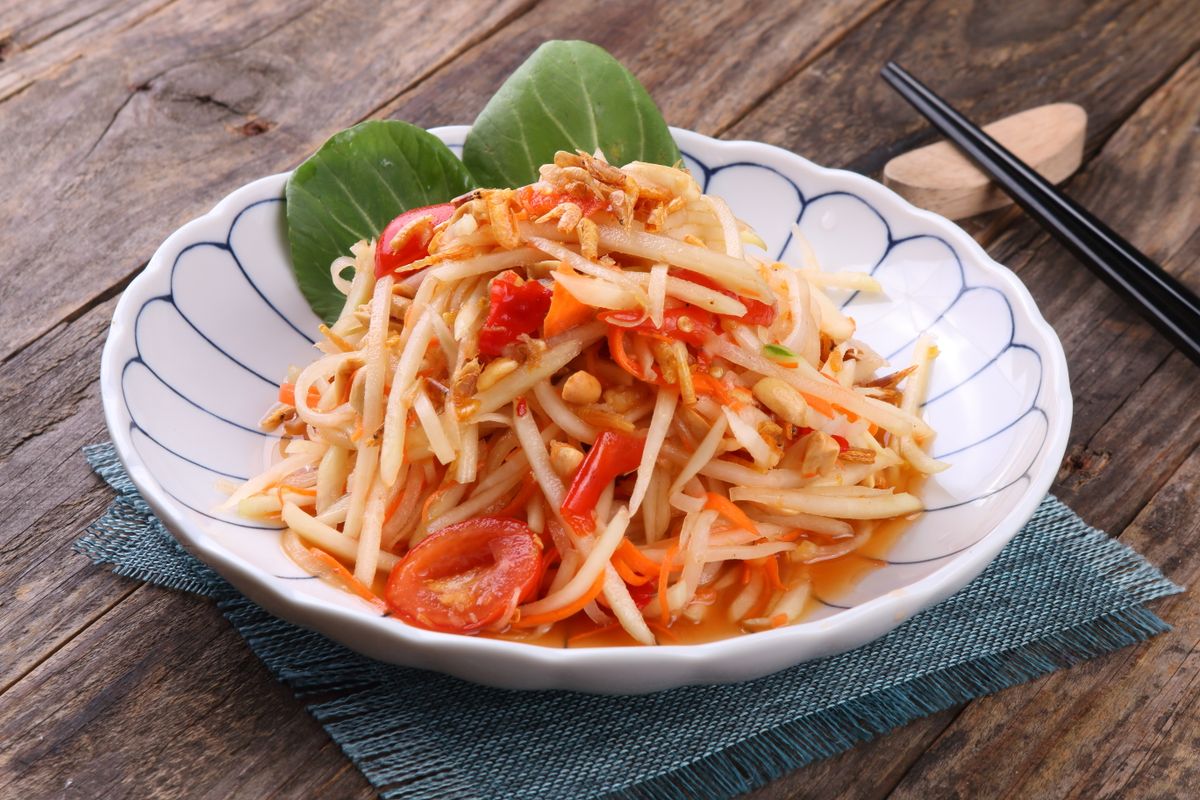
Thai Som Tam Green Papaya Salad with Lime and Peanuts
A vibrant Thai som tam made from crunchy unripe papaya, long beans, cherry tomatoes, roasted peanuts and a balanced spicy-sour fish-sauce dressing.
🍽️ Original recipe: 4 servingsThe original quantities and written steps are for 4 servings. Changing the number scales only the ingredient checklist, not method or cooking times. Cook larger batches in appropriate pans.
Jump to ingredients · Jump to method
Cooking times vary with equipment and ingredient size; look for the stated texture and doneness cues.
🛒 Ingredients checklist
👩🍳 Step-by-step method
Select genuinely unripe papaya and shred safely
Choose 500 g peeled green papaya whose flesh is pale and firm, not sweet ripe orange flesh beneath green skin. Wash the outside before peeling and remove the seeds, then julienne into thin matchsticks with a clean sharp knife or papaya grater. Handle the knife or mandoline cautiously.
Soak shredded papaya briefly and drain dry
Place the 500 g julienned papaya into the measured 800 ml clean cold drinking water for about ten minutes to improve crunch. Lift into a sieve and pat dry well with clean cloth or paper so the lime and fish sauce dressing is not diluted. Discard the soaking water rather than adding it to the salad.
Wash tomatoes, cut long beans and check seafood labels
Wash 180 g cherry tomatoes and halve them; rinse 100 g Thai long beans and cut to 2–3 cm pieces. Check that 25 g dried shrimp is sold ready to eat, without any required cooking instruction, and chop coarsely. Keep seafood away from peanut-free utensils for anyone with allergies.
Crush fresh garlic and chilli with a mortar
Put 14 g peeled garlic and 12 g fresh Thai chillies in a clean large mortar. Pound gently until the garlic breaks into small pieces and chilli juices release, avoiding an extremely fine paste that would hide the fresh texture. Use fewer seeded chilli pieces if a mild salad is preferred.
Dissolve palm sugar in the lime and fish sauce
Add 28 g finely shaved palm sugar to the mortar along with 65 ml lime juice, 40 ml fish sauce and 18 ml prepared tamarind. Stir with a clean spoon, occasionally pressing the sugar until fully dissolved. The dressing should be boldly sour, salty, sweet and spicy rather than thick like a dip.
Bruise beans and tomatoes, then mix peanuts
Add cut long beans and lightly pound them 3–4 times until just cracked, not crushed into pulp. Add the halved tomatoes, 25 g prepared dried shrimp and 50 g of the measured 70 g crushed peanuts. Fold with a spoon so tomato juices join the dressing and the beans absorb flavour.
Fold in green papaya and bruise gently
Add the thoroughly drained 500 g green papaya shreds to the mortar in several portions. With a large clean spoon and pestle, lift from the base while lightly tapping the papaya so dressing coats all strands. If the mortar is too small, transfer to a wide bowl and massage gently with clean food gloves.
Serve four fresh portions with the remaining peanuts
Divide the freshly dressed papaya salad between four clean bowls and scatter the final 20 g roasted peanuts over the top. Serve immediately for a crisp texture; refrigerate any leftovers promptly at 5°C or colder and use early because the papaya will soften in the lime dressing.
Helpful cooking tips and swaps
Use truly unripe papaya and only lightly bruise the vegetables; the dressing should be bold, not creamy. Dress just before eating for crunch.
🌡️ Food safety and allergens
Contains peanuts, crustacean shellfish (dried shrimp) and fish (fish sauce). Verify that dried shrimp is labelled ready to eat and check all allergen statements.
Serve fresh; refrigerate any leftover seafood-containing salad promptly at 5°C or below and avoid long warm holding.
Practical FAQs
Can I make a bigger batch?
Yes. Use the ingredient scaler but adjust the number of pans or batches. Cooking time does not automatically scale with quantity.
How should leftovers be stored?
Serve fresh; refrigerate any leftover seafood-containing salad promptly at 5°C or below and avoid long warm holding.
Food safety source: Food Standards Australia New Zealand