Korean Vegetable and Egg Gimbap
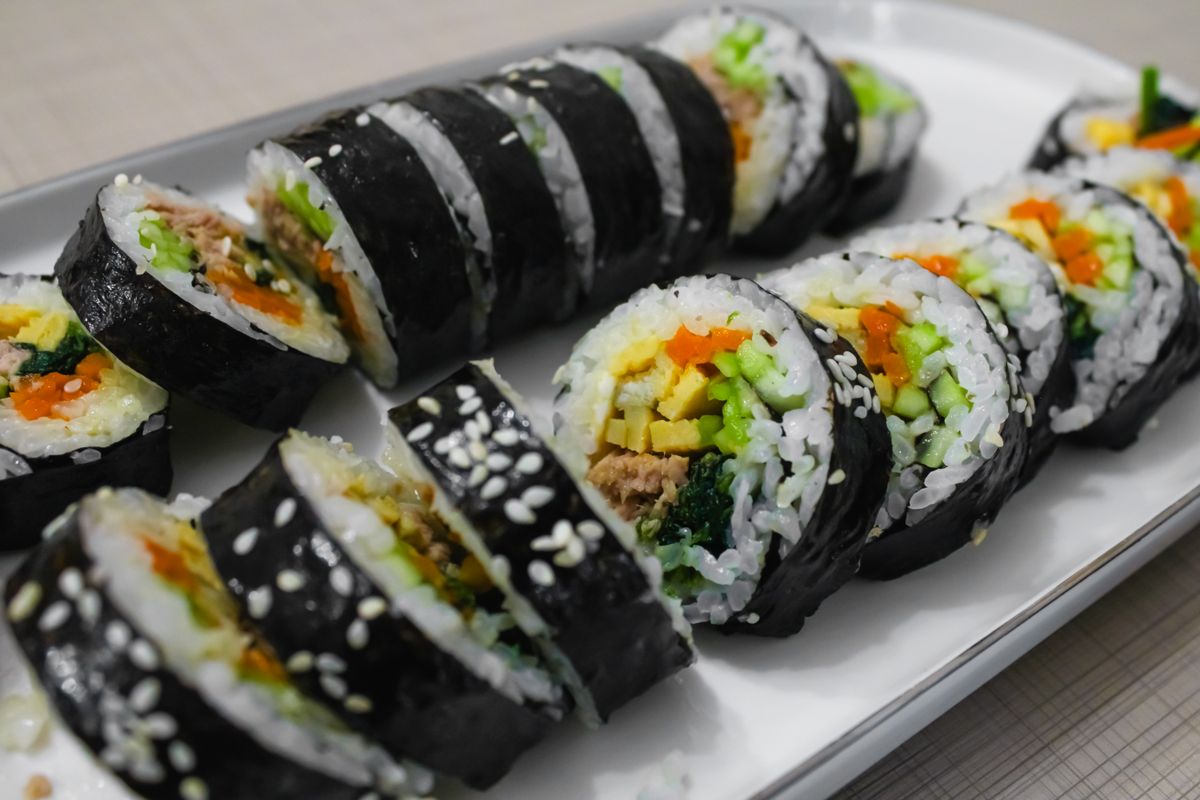
Four Korean-style rice and seaweed rolls filled with seasoned spinach, carrots, pickled radish and fully cooked egg, with a detailed beginner-friendly rolling method.
🍽️ Original recipe: 4 servingsThe original quantities and written steps are for 4 servings. Changing the number scales only the ingredient checklist, not method or cooking times. Cook larger batches in appropriate pans.
Jump to ingredients · Jump to method
Cooking times vary with equipment and ingredient size; look for the stated texture and doneness cues.
🛒 Ingredients checklist
👩🍳 Step-by-step method
Wash and cook the measured short-grain rice
Rinse 260 g Korean short-grain rice until water runs less cloudy, drain and add to a tight-lidded pot with 390 ml drinking water. Bring briefly to a boil, then cook covered on low heat for roughly 13–16 minutes until absorbed. Rest covered five minutes, then spread warm rice in a wide clean bowl; never let cooked rice sit overnight at room temperature.
Season warm rice with sesame oil and salt
While rice is warm, gently fold in 16 ml of the measured 28 ml sesame oil, 3 g of the 5 g salt and the 10 g toasted sesame seeds. Use a rice paddle to lift and turn instead of crushing grains until glossy and evenly seasoned; keep loosely covered while preparing fillings.
Blanch spinach, drain and season thoroughly
Bring 900 ml clean drinking water to a boil in a saucepan. Add rinsed 200 g spinach and blanch for about 35–45 seconds until just wilted, then drain and rinse briefly with cool drinking water. Squeeze firmly until no water drips; toss with 6 ml sesame oil, 5 g minced garlic and 1 g salt.
Sauté thin carrot strips without making them mushy
Heat 8 ml of the measured 15 ml neutral oil in a non-stick pan over medium heat. Add 180 g finely julienned carrot and stir for about 2–3 minutes until more flexible but still brightly orange. Sprinkle the final 1 g salt over the carrot, then remove to a clean plate and cool.
Make a fully cooked thin egg omelette
Beat the three large eggs thoroughly in a bowl. Warm the remaining 7 ml neutral oil in the pan over medium-low heat, pour in egg and tilt to form a thin sheet. Cook about 2–3 minutes until there is no wet egg remaining, then carefully turn or cover for another minute until fully set; cool and slice into long strips.
Prepare cucumber and pickled radish for even rolling
Wash 120 g cucumber, remove the wet seedy centre and cut into four long strips. Drain 120 g yellow pickled radish and divide into four long batons. Put the cooled spinach, carrots, egg, cucumber and radish into separate clean piles beside a bamboo rolling mat.
Fill one of four gim sheets thinly and roll firmly
Place one of the four gim sheets shiny-side down on the rolling mat. Spread one quarter of the sesame-seasoned rice into a thin even layer leaving a 2 cm empty strip at the far edge. Arrange one quarter of each prepared filling across the lower third, fold the mat over once to secure and roll forward firmly without trapping the mat inside.
Slice all four rolls and serve promptly
Repeat the roll with the remaining three gim sheets and fillings. Brush the outside with the final 6 ml sesame oil, then use a sharp clean knife lightly dampened with drinking water to cut each roll into about eight pieces. Serve immediately; refrigerate extra rice-and-egg rolls promptly at 5°C or colder, never leaving them in a warm lunchbox for hours.
Helpful cooking tips and swaps
Korean gimbap seasons rice with sesame oil rather than sushi vinegar. Fully cook eggs and squeeze spinach dry to keep gim from becoming soggy.
🌡️ Food safety and allergens
Contains egg and sesame; check packaged pickled radish for declared allergens and any non-vegetarian additives.
Rice and egg gimbap must not be kept warm for hours. Serve promptly or refrigerate quickly at 5°C or colder; best eaten on the day of preparation.
Practical FAQs
Can I make a bigger batch?
Yes. Use the ingredient scaler but adjust the number of pans or batches. Cooking time does not automatically scale with quantity.
How should leftovers be stored?
Rice and egg gimbap must not be kept warm for hours. Serve promptly or refrigerate quickly at 5°C or colder; best eaten on the day of preparation.
Food safety source: Food Standards Australia New Zealand